Why Bathroom Pest Problems Cost More Than You Think: A Budget Guide to Prevention and Professional Treatment
Learn why bathroom pest problems can cost more than expected, with budgeting tips for prevention, early detection, and professional pest treatment.
If you spend your days thinking about how a workspace should feel, whether that's a home office corner or a converted guest room, you already understand how much small details affect a space. A chipped baseboard, a water stain on the ceiling, or a line of ants marching across bathroom grout can undo the calm of an otherwise well-designed room in seconds. Pest problems are not just a kitchen or basement concern. They quietly erode the comfort of every room in the house, including the bathroom you walk through every morning before heading to your home office.
Many homeowners treat a few ants near the sink or a trail along the tile as a cosmetic annoyance rather than a financial warning sign. That assumption gets expensive. Bathrooms combine moisture, warmth, and organic residue, which makes them one of the most attractive environments for ants, roaches, and even termites looking for a way into wall cavities. The cost of ignoring that attraction rarely shows up immediately. It shows up months later as a larger infestation, a damaged subfloor, or a bigger invoice than the original problem ever warranted.
Grout lines are especially vulnerable because they crack, absorb moisture, and create tiny highways pests use to move between walls and plumbing chases. Homeowners dealing with ants in bathroom grout Marietta often discover that the visible ants are only a fraction of the colony living behind tile or beneath a vanity. Treating the surface without addressing the entry points is a bit like repainting a wall before fixing the leak underneath it. The cost of doing it twice almost always exceeds the cost of doing it right the first time.
Why Bathroom Pests Cost More Than You Think: Hidden Damage and Structural Risks
The real expense of bathroom pests rarely lives in the pests themselves. It lives in what they damage while they are there. Moisture-seeking insects are drawn to leaky supply lines, condensation around tubs, and damp subfloor material, and their presence is often the first visible clue that a slow leak has been active for weeks or months. By the time ants or small roaches become a pattern rather than a one-off sighting, there is a reasonable chance that moisture damage is already developing somewhere nearby.
Termites take this risk even further because they target structural wood rather than crumbs or moisture alone. A bathroom built on or near a slab, or one with wood framing behind the shower surround, can become a termite entry point without any obvious signs until the damage is significant. According to Consumer Affairs, a homeowner with termites spends an average of $3,000 to repair the resulting damage, which makes early identification and preventive treatment a far more cost-effective choice than waiting for visible destruction. That single statistic reframes pest control from an optional service into a structural investment.
Breaking Down the True Cost: Professional Treatment vs. DIY Attempts
It is tempting to grab a spray bottle from the hardware store and call it handled, and for isolated, minor sightings that approach sometimes works. But most DIY products are designed to kill visible insects, not the colony structure feeding them. Over-the-counter treatments typically cost between $5 and $50, which sounds like a bargain until the same ants return two weeks later because the nest was never disrupted.
Professional treatment costs more upfront, but it addresses the source rather than the symptom. A single professional pest control visit averages $171 nationally, with a realistic range of $50 to $500 depending on the pest and severity of the infestation. Ant-specific treatment typically runs $100 to $500, and carpenter ants, which chew through wood rather than simply foraging in it, tend to cost about 30 percent more because of the additional structural inspection involved. The table below lays out how these costs compare across common scenarios homeowners actually face.
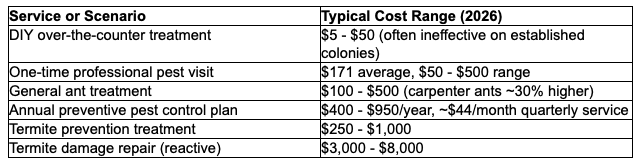
The pattern in that table is hard to miss. Prevention and early treatment consistently cost a fraction of what structural repair demands later. A homeowner who spends $300 on a one-time ant treatment is spending roughly a tenth of what termite damage repair might cost if the problem is left to compound unnoticed behind bathroom tile.
Where to Spend and Where to Save: Prevention Strategies That Deliver ROI
Not every dollar needs to go toward a service call. Simple habits like wiping down wet surfaces, fixing dripping faucets promptly, and sealing grout lines once a year cost very little and remove the moisture and food sources that attract pests in the first place. These small maintenance tasks are the pest control equivalent of dusting a shelf before it becomes a dumping ground, the kind of low-effort habit that prevents a much bigger cleanup later.
Where spending actually pays off is in professional inspection, especially for homes with older plumbing, slab foundations, or a history of moisture issues. An inspection costs far less than the infestation it might catch early, and it gives homeowners a clear picture of what is happening behind the walls rather than a guess based on what crawls across the floor. The same logic that applies to designing a functional room applies here: thoughtful, intentional choices upfront save money and frustration down the line, much like the ideas for arranging a room discussed in fill empty wall space, where small deliberate decisions prevent a space from feeling neglected or disorganized.
Building a Long-Term Budget: Preventive Plans vs. Emergency Treatments
Annual preventive pest control plans typically run between $400 and $950 per year, with quarterly service averaging around $44 per month. That steady, predictable cost is easier to budget for than an emergency call that arrives after an infestation has already taken hold, and it usually includes routine inspections that catch moisture or structural issues before they escalate. Homeowners who treat pest control as a recurring line item, similar to HVAC maintenance or gutter cleaning, tend to avoid the sudden four-figure repair bills that reactive homeowners face.
Emergency treatments, by contrast, are reactive by nature and almost always cost more per visit because the problem has had time to spread. A bathroom that goes from a minor ant trail to a full infestation over several months may require multiple visits, follow-up inspections, and in worst cases, repair work for damaged subfloor or framing. Budgeting a modest annual amount for prevention is, in nearly every documented cost comparison, a smarter long-term financial decision than waiting for a problem serious enough to demand immediate professional attention.
Stay up to date with our latest ideas!