Does Your Home Office Actually Add Value? What Converted Bedrooms, Garages, and Backyard Offices Do to Resale
Learn how home offices affect resale value, including converted bedrooms, garages, and backyard offices, plus the factors that influence buyer appeal.

You finally have the office you wanted. The question almost nobody asks until years later is what it did to the house.
The honest answer depends on almost nothing to do with how the office looks. Resale value turns on a handful of unglamorous technicalities: where the space sits, how it's heated, whether a permit was pulled, and whether the conversion quietly took away something buyers count. Two owners can spend identical money on a home office and end up in completely different positions at closing.
Appraisers don't measure square footage the way you do
Your tape measure and an appraiser's are answering different questions. The general convention in residential appraisal — reflected in the ANSI Z765 measuring standard that many lenders now require for single-family work — treats finished living area as space that is above grade, finished to roughly the same standard as the rest of the house, heated and cooled by the home's system, and reachable without walking through an unfinished area first.
That is a convention, not a universal law. Jurisdictions differ, appraisers exercise judgment, and some markets handle finished basements more generously than others. But the broad shape holds: a beautifully finished basement office is usually reported separately from above-grade living area rather than folded into it, and space that is unheated, unfinished, or only accessible through a garage or utility room tends not to count as living area at all. Which is why "I added 200 square feet of office" and "I added 200 square feet of gross living area" are frequently not the same sentence.
The office that quietly costs you a bedroom
Bedroom count is a sorting mechanism. Buyers filter searches by it, and appraisers select comparable sales by it. A three-bedroom and a four-bedroom of identical size can sit in different brackets entirely.
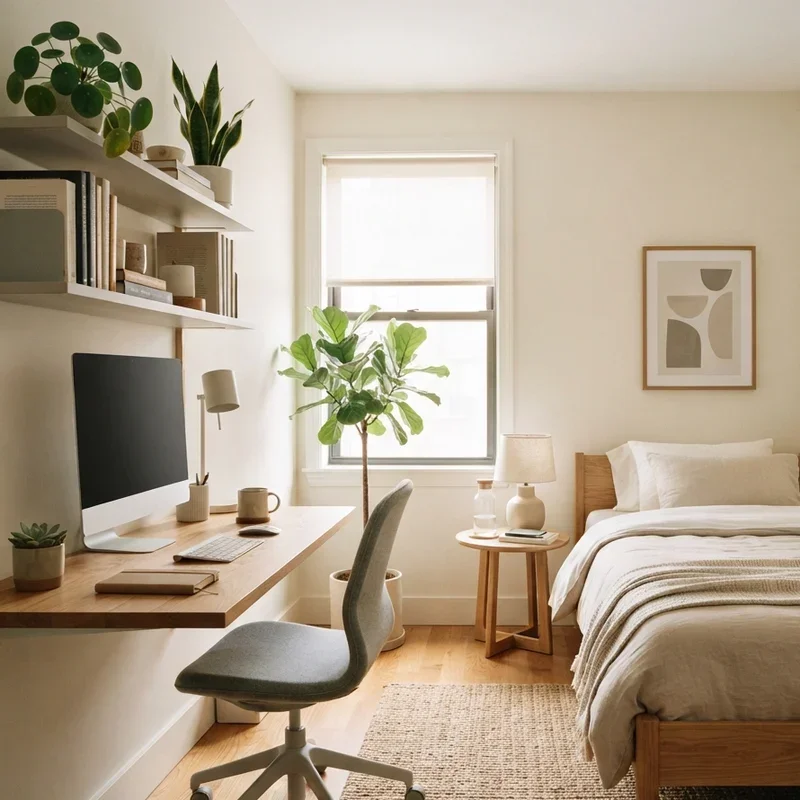
Using a bedroom as an office costs you nothing — the room is still a bedroom, and a desk is not a renovation. The risk shows up when the conversion is physical. Remove the closet for a built-in desk wall, frame over the doorway, or knock out the wall into the adjacent room to make one large studio, and you may have turned a four-bedroom house into a three-bedroom house on paper.
What qualifies as a bedroom varies by market and by local code — closet requirements in particular are less universal than people assume, while egress and ceiling-height requirements are more consistently enforced. The safe read: if the room can no longer function and be described as a bedroom, expect the listing, the appraisal, and the buyer pool to reflect that.
Garage conversions can subtract as well as add
This is the one that surprises people, because it's the conversion that feels like the biggest win. You gained a private, separate, already-enclosed room without building an addition.
But in most suburban markets, covered parking is a feature buyers pay for and appraisers adjust for. Removing it moves the house into a different comparison set — one where every competing listing still has a garage. And converted garages often fail to earn living-area credit on the other side of the ledger, because the telltales are visible: a slab sitting a step below the rest of the floor, a framed-and-sided opening where the door was, a mini-split doing work the home's HVAC system doesn't, insulation that stops at the studs.
The worst outcome is the double hit — losing the garage credit without gaining the living-area credit. The conversions that fare best are done thoroughly enough that the space reads as original construction, in neighborhoods where off-street parking is abundant or irrelevant.
Detached backyard offices are treated as improvements, not living area
Garden offices and backyard pods have become genuinely popular, and they solve the separation problem better than anything inside the house. They also sit in a different valuation category.
Because a detached structure isn't part of the main dwelling, it generally isn't added to living area under the conventions above. Appraisers typically treat it as a site improvement with contributory value — a judgment call informed by what the local market has actually paid for similar structures, which is often well below what the pod cost to build and install.
Contributory value climbs when the structure is permitted, set on a permanent foundation, conditioned year-round, and wired properly with its own circuit and data. It falls toward "nice shed" when it's a temporary building on skids running off an extension cord. Local rules on accessory structures matter too — setbacks, lot coverage, height caps, and whether plumbing is allowed at all differ enormously between municipalities, and a structure that violates them is a complication at sale rather than an asset.
Permits are where the real risk lives
Unpermitted work is not a paperwork annoyance. It's a transaction problem, and it surfaces in three predictable places.
A lender can decline to finance or attach conditions when the appraisal notes work that doesn't appear in public records. An appraiser can decline to give value to unpermitted finished space, or flag it for the underwriter. And a buyer's inspector will find it — bootleg wiring behind new drywall, a bedroom window that doesn't meet egress, a missing fire separation where a garage used to be, an HVAC system asked to condition more area than it was sized for.
Most states also require sellers to disclose known material facts, and known unpermitted work generally qualifies. Retroactive permitting exists in many jurisdictions, but it's rarely cheap or quick: expect inspections, opened walls, potential rework, and sometimes a requirement to bring adjacent systems up to current code.
What's reversible and what isn't
Before any conversion, it's worth sorting the work into two piles. Generally reversible, at modest cost:
Built-in desks, shelving, and surface-mounted cable runs
A removed closet, if the framing and flooring underneath weren't altered
Paint, flooring, and lighting decisions
A door removed to open sightlines, as long as the header and opening stayed intact
The other pile is where value gets locked in or locked out. Rolling a garage slab up to floor height, removing a garage door opening and residing the wall, relocating plumbing, cutting structural openings between rooms, or replacing an egress window with a smaller fixed unit are all expensive to undo — and each one is a decision about who can buy your house later, made years in advance.
When the work can't be undone or permitted after the fact
Sometimes you inherit the problem, or the retroactive permit quote comes back higher than the space is worth. At that point there are three real options, and all three are legitimate.
You can permit it retroactively where your jurisdiction allows it and absorb the cost. You can restore the space to its original configuration, which is usually cheaper than full compliance and puts the house back in the mainstream buyer pool. Or you can disclose it and sell as-is, pricing the condition in rather than fixing it — which typically means looking past the conventional financed buyer. In the St. Louis market, for example, owners in that spot often compare a retroactive permit estimate against what a cash home buyer in St. Louis would pay for the house exactly as it stands, unpermitted office and all, because that kind of buyer isn't waiting on an appraiser's opinion of living area or a lender's sign-off. A financed buyer can still work, too — it just usually arrives as a price concession, an escrow holdback, or a repair negotiation instead.
A home office adds value when it adds finished, conditioned, permitted space without removing something buyers count. It costs value when it trades a garage, a bedroom, or a clean permit history for a room that only one household — yours — was ever designed around. The work doesn't have to be reversible. It just has to be a decision you made on purpose.
Stay up to date with our latest ideas!