Two Numbers that Decide Whether a Linear LED Line Works Over a Desk
Learn the two key numbers that determine whether a linear LED light works over a desk, helping you achieve comfortable, effective task lighting.

A workspace lighting specification covers lumens per watt, color temperature and controls. Two things it leaves out – glare and junction heat – are decided by the channel rather than the strip, and both come back later as complaints.
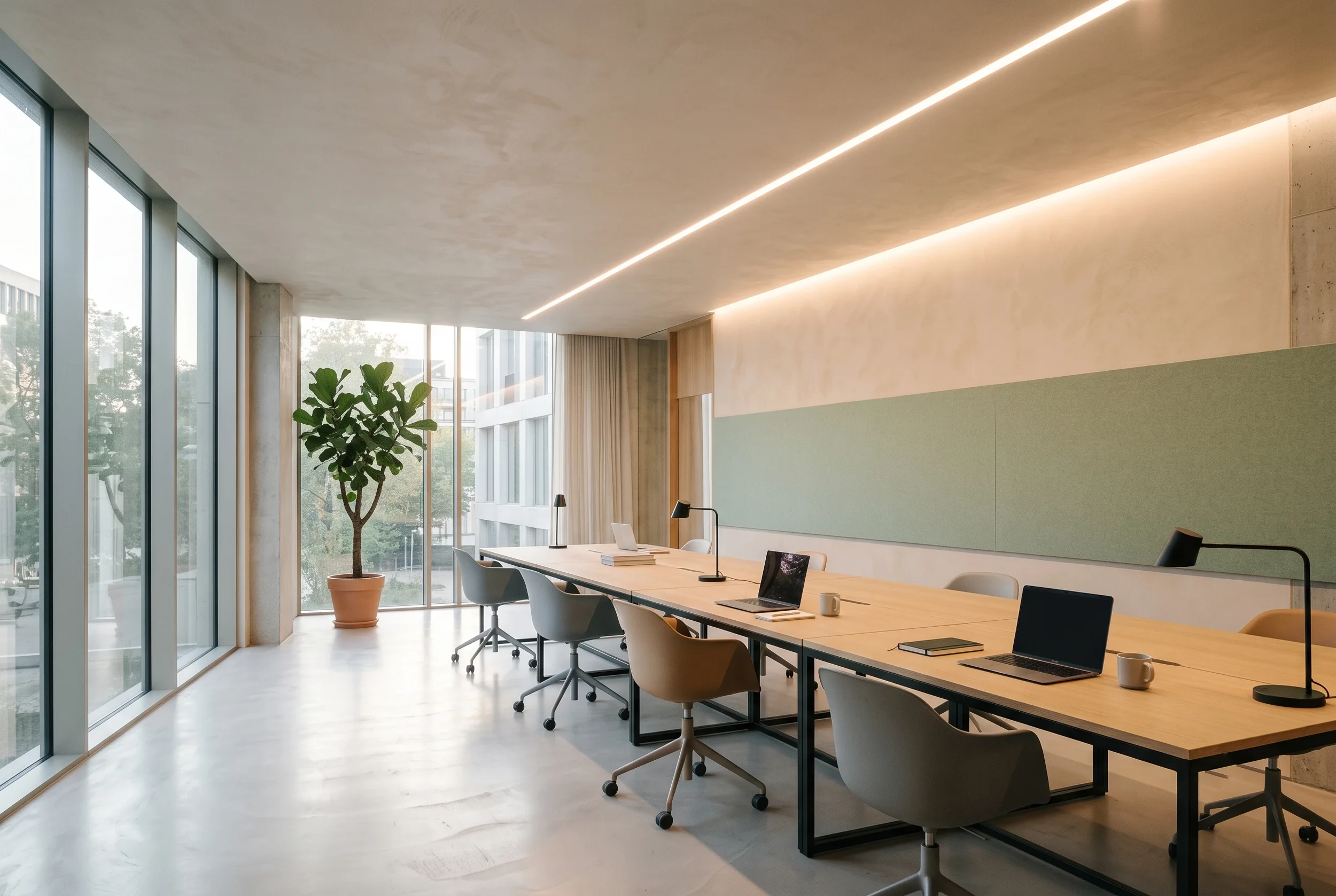
A continuous line of light is the default gesture in workspace design now: a clean run along a ceiling, or a slot above a desk. The specification written for it usually stops at the strip – lumens per foot, CCT, CRI, wattage, dimming protocol. Those numbers describe the part you can swap in an afternoon. The aluminum channel carrying the strip does the work people actually notice, and it tends to get nothing more than a finish code on the drawing.
Two of its properties decide whether the room is still comfortable to work in a year later: how the channel controls glare, and how it moves heat away from the diodes. Neither appears on a strip datasheet. Both are published by manufacturers that take them seriously, which makes them straightforward to specify once you know to ask.
Glare is why people dislike a well-lit office
A bright line of exposed diodes reads as harsh rather than bright. The response is predictable. Occupants bring in task lamps, or the space gets driven harder so it feels comfortable, and that extra load is energy spent fixing something the optic should have handled in the first place.
The control is the diffuser, and unlike a finish note reading „opal”, a glare rating is a number you can hold a supplier to. Micro-prismatic film diffusers now bring a recessed plasterboard channel to UGR < 17, and a lens option on the same bodies reaches UGR < 16 – both tighter than the UGR ≤ 19 that EN 12464-1 asks for in offices and screen-based work. An opal diffuser gives a soft, dot-free line and trades a little output for comfort. Clear keeps more lumens, but only works where the source stays out of everyday sight lines, which in a room full of seated people looking at monitors is a narrower set of positions than it looks on a section drawing.
For any surface where someone reads or works at a screen, put the glare number on the plan and let it choose the diffuser. The room then gets lit to the level it actually needs, instead of being overshot to mask discomfort.
Heat decides how long the light stays the color you specified
An LED’s output and color stability track its junction temperature. Run a strip hot and it dims and drifts faster, which means the installation either gets over-specified up front or replaced early. The aluminum channel is the heat sink that sets how hot the strip runs, and that makes it a performance component rather than a housing.
A manufacturer treating it that way rates the channel in watts per meter at a stated ambient. Published figures across one plasterboard range give the shape of it: a 35 mm recessed body carries 40 W/m, a 55 mm body 45 W/m, and a wide 70 mm body 50 W/m. Polished-aluminum reflectors inside those bodies recover roughly 20% of output, which is a straight efficiency gain rather than a marketing one – the same light arrives at the diffuser face from less input, so the strip can be specified a step lower.
The practical rule is to take the strip’s real wattage and choose a channel rated above it at the temperature the ceiling void actually runs. Plenums sit at 30–35 °C, not the 25 °C printed on the spec sheet. A channel sized to its limit in a hot cavity is a service call scheduled for eighteen months from now.

Where the two numbers change the drawing
The two constraints do not land evenly across a floor plate. Glare governs wherever people sit still and look at screens, so it drives the diffuser choice over open-plan desks, in meeting rooms and along any run that falls inside a seated field of view. Thermal headroom governs wherever the channel is buried and the run is long – a closed plasterboard ceiling with no air movement is a very different thermal environment from a surface profile on an exposed soffit, even with identical strip in both.
That is the useful split when a budget forces a choice. Spend the glare rating where people work, and spend the thermal headroom where the profile is enclosed. Specifying both everywhere is fine too, but knowing which one is doing the work in each zone is what stops a value-engineering conversation from quietly removing the wrong thing.
Two habits worth adopting before the ceiling closes
Neither costs more than getting it wrong. Pick the diffuser by glare rating for any room where people work, and size the channel’s watts per meter above the strip load at the real ambient rather than the catalogue one. Together they remove the two failures that make a linear line disappointing in practice: the temptation to over-light a glary room, and the early replacement of a strip that cooked quietly above a plasterboard line.
The engineering is already done and published. Manufacturers such as Ledson state the glare figure and the thermal limit per profile, which is exactly the data this decision needs. Reading those two numbers before the channel goes in is the difference between a light line people stop noticing and one they keep mentioning.
Stay up to date with our latest ideas!