How to Choose Industrial Wall Fans for Large Warehouses
Learn how to choose industrial wall fans for large warehouses by evaluating airflow, coverage area, energy efficiency, and installation needs.
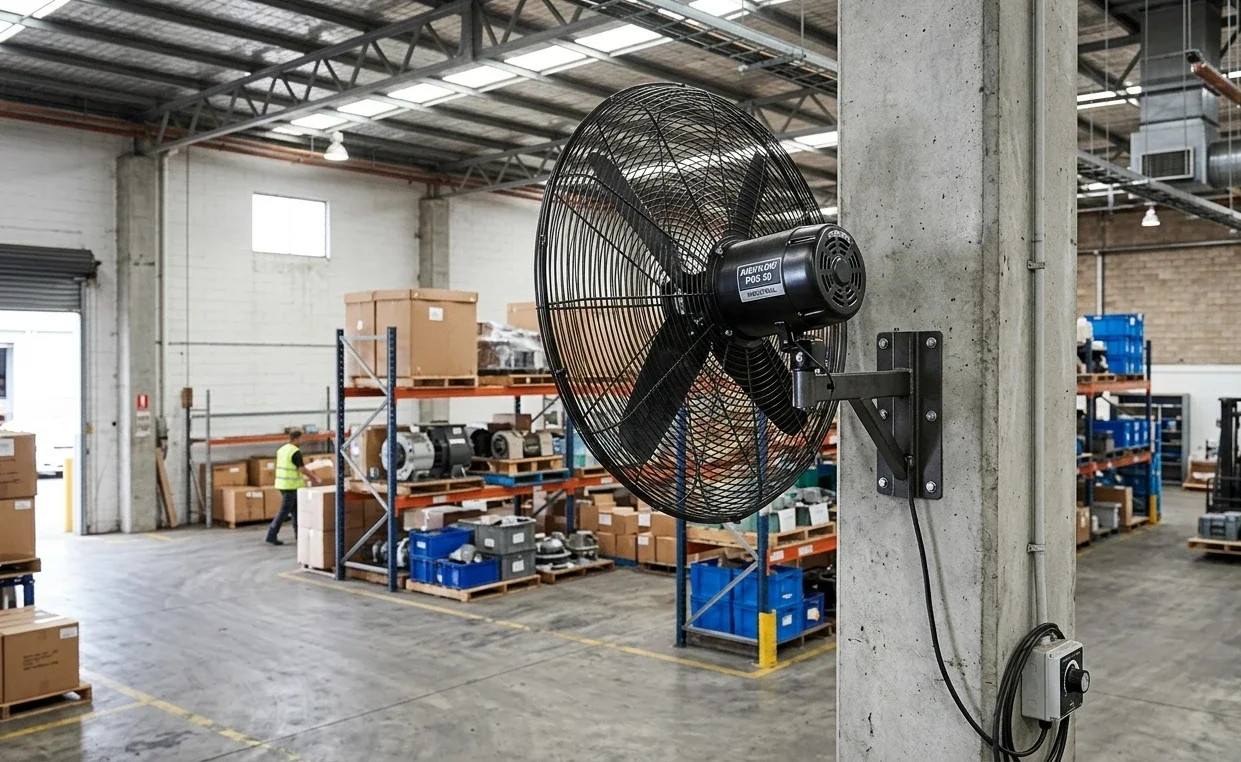
Most warehouse managers buy fans based on price alone, then spend the next summer wondering why three units can't cool a 50,000-square-foot space. The wrong fan doesn't just leave workers uncomfortable; it wastes electricity and fails within two years. Skip the guesswork.
This guide walks you through airflow math, mounting decisions, and motor specs so you can choose industrial wall fans for large warehouses without second-guessing every purchase.
Airflow Capacity and CFM Requirements
Here's the thing: industrial wall fans for warehouses need to move enough air to cover your full floor area, not just the zone directly beneath the unit. The rule most HVAC engineers use is a minimum of 1 CFM (cubic feet per minute) per square foot of floor space; high-heat environments like metal fabrication shops often push that to 1.5 CFM per square foot.
Calculating CFM for Your Warehouse Size
Start with your floor area in square feet, then multiply by your target CFM rate. A 40,000-square-foot warehouse with moderate heat loads needs at least 40,000 CFM total. Divide that by the rated CFM of a single fan to get your unit count. Don't forget ceiling height; spaces taller than 20 feet lose airflow performance. Add 10- 15% to your total to compensate.
Fan Diameter vs. Airflow Output
Blade diameter directly controls how much air a fan moves per rotation. A 24-inch wall fan typically delivers 4,000 to 6,000 CFM. A 36-inch unit can reach 10,000 to 14,000 CFM. So if you're tempted to buy smaller fans to save space, you'll likely need twice as many units to hit the same coverage. Larger blades at lower RPM also tend to run quieter.
Multi-Speed Controls and Variable Airflow
Fixed-speed fans are cheaper upfront, but they run at full power regardless of conditions. A three-speed motor or variable frequency controller lets you adjust airflow on cooler days, which cuts electricity consumption by up to 50% at medium speed according to Department of Energy motor performance data. For warehouses that operate year-round, that flexibility pays for itself fast.
Motor Type, Build Quality, and Safety Ratings
The motor is the part you can't see after installation; it's also the part that decides whether a fan lasts three years or fifteen. Get this wrong, and you'll be remounting replacements on a scissor lift every other season.
TEFC vs. Open Drip-Proof Motors
Totally Enclosed Fan-Cooled (TEFC) motors seal the windings against dust, moisture, and chemical vapors. Open Drip-Proof (ODP) motors cost less but leave internal components exposed to the warehouse environment. In spaces with sawdust, metal shavings, or spray paint fumes, an ODP motor will clog and overheat within months. TEFC is the default choice for any industrial setting.
IP and UL Ratings to Look For
IP (Ingress Protection) ratings tell you exactly what the motor housing blocks. IP44 handles splashing water and solid particles above 1mm. IP55 blocks dust and low-pressure water jets. Cold-storage warehouses or wash-down areas? IP66 is the minimum. UL listing confirms the unit meets U.S. electrical safety standards; most insurers and facility inspectors now require it before sign-off.
Mounting Bracket Load Ratings
Wall fans in large warehouses often weigh 40 to 80 pounds. The bracket must exceed that weight by a safety factor of at least 4:1; a 60-pound fan needs a bracket rated for 240 pounds. Concrete anchors into CMU block hold reliably; wood-stud walls require through-bolting to a horizontal header. Check the manufacturer's spec sheet before you order, not after the fan arrives.
Placement Strategy and Coverage Patterns
Buying the right fan and mounting it in the wrong spot is one of the most common mistakes in warehouse ventilation. Placement determines whether you get full-floor circulation or just a strong breeze in one corner.
High-Sidewall vs. Mid-Wall Mounting Heights
Fans mounted at 10 and 14 feet direct airflow across the work zone where people actually stand. Fans mounted above 18 feet send air into the upper third of the building, which helps with heat destratification but won't directly cool floor-level workers. In spaces with both high ceilings and ground-floor activity, a two-tier approach works better; one row at 12 feet and one at 20 feet addresses both problems.
Angling Fans for Cross-Ventilation
A fan aimed straight across a warehouse creates a single strong airflow channel, with dead zones on either side. Angle units 15, 20 degrees toward the center aisle, and you get a wider coverage pattern. In facilities with racking systems, aim fans down the aisle length rather than across it; obstructions kill airflow faster than distance does.
Spacing Units Across the Wall
Most 24-inch industrial wall fans cover an effective radius of roughly 30 to 40 feet. Space units no more than 60 feet apart to avoid gaps in coverage. Mark your floor plan with circles representing each fan's effective radius before you order; overlapping zones by 10, 15 feet beats discovering dead spots after installation.
Conclusion
Choosing industrial wall fans for large warehouses comes down to three things: matching CFM output to your floor area, selecting a motor built for your specific environment, and placing units where they move air at the worker level. Get your CFM math right first. Spec a TEFC motor with the appropriate IP rating for your conditions. Map fan positions on paper before you buy. You'll save a lot of rework later.
Stay up to date with our latest ideas!