Discover why workplace appliance failures disrupt business tech, reduce productivity, and create costly downtime across modern office environments.
Modern offices run on more than software and Wi-Fi. The physical layer — HVAC units, commercial kitchen equipment, server room cooling, water systems — quietly holds everything together. When it breaks, it doesn't just inconvenience someone. It knocks out productivity chains that businesses spent years building. This article looks at how appliance failures ripple through workplace tech ecosystems in 2026, why most companies still aren't prepared, and what the smarter ones are doing differently.
The Office Has a Hardware Problem Nobody Talks About
Here's a scenario that played out at a mid-size marketing agency in Austin last winter. The commercial HVAC unit in their server closet failed on a Tuesday morning. By noon, two workstations were overheating. By 3 PM, their project management platform threw errors. By end of day, the team had lost six hours of billable work — not because of a software bug or a cyberattack, but because a compressor gave out.
Nobody had a repair ticket system. Nobody tracked maintenance schedules. The facilities manager was working off a paper log from 2021.
That story is more common than it sounds.
Service businesses — the ones that actually fix broken appliances — have started adopting purpose-built scheduling and dispatch platforms to keep up. Companies using appliance repair business software like MrTask are cutting response windows from days to hours by automating job assignments, tracking technician availability in real time, and keeping client history in one place. For the end client — meaning the office that called for help — that speed difference is the gap between a one-day disruption and a week-long one.
The infrastructure side of office management has been underinvested for years. Software got all the attention. Hardware maintenance got a Post-it note on the break room fridge.
What "Appliance Failure" Actually Costs a Modern Office
Let's get specific, because the abstract "lost productivity" framing doesn't land.
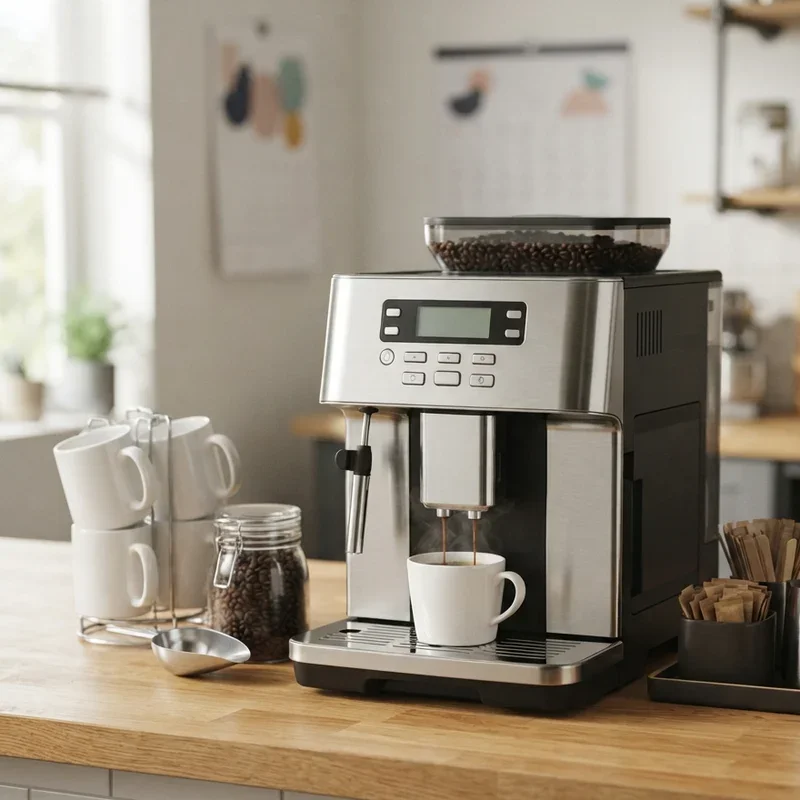
A coffee machine breakdown in a 40-person office sounds trivial. It isn't. Research from facilities management firm Leesman has consistently shown that ambient comfort — including access to hot drinks, temperature, and noise levels — directly correlates with reported focus quality. Remove the morning coffee ritual and you're not being dramatic when you say morale takes a hit by 10 AM.
Scale that up. A broken refrigeration unit in a law firm's server room raises ambient temperature by 8–10°F within four hours. At that temperature, hard drive failure rates climb measurably — IBM published internal data showing that every 10°C rise above 35°C roughly doubles component failure probability. The office didn't lose a fridge. It lost its document storage system.
Or consider water damage. A slow leak under a raised floor took out the network switch stack in a Chicago financial firm's trading floor in late 2024. Damage assessment: $340,000. Root cause: a corroded pipe fitting nobody had looked at in three years.
The Tech Stack Is Only as Stable as the Building It Lives In
This is the point most IT departments still haven't internalized. Digital infrastructure has a physical dependency that gets ignored until something burns, floods, or freezes.
Think about what a modern office actually runs on:
Structured cabling that runs through walls, ceilings, and under floors — all of it vulnerable to water, heat, and pest damage
PoE switches and wireless access points mounted in equipment closets that weren't designed for today's heat loads
UPS systems that haven't been load-tested since installation
Building automation systems (BAS) that control HVAC, lighting, and access — often running on Windows 7 embedded, by the way
The BAS point deserves a pause. Siemens, Johnson Controls, and Honeywell all sell building automation platforms that are genuinely sophisticated. But the installations in most mid-market commercial buildings are 10–15 years old, running outdated firmware, and maintained by whoever the property manager could get on short notice. When those systems fail, they fail quietly — a set-point drift here, a stuck damper there — until the data center room is running at 85°F and nobody noticed because the alert email went to a decommissioned inbox.
Why Field Service Tech Is Becoming a Business Continuity Tool
Here's a shift worth paying attention to. The companies that repair and maintain physical infrastructure (HVAC techs, electricians, plumbers) have historically operated on paper logs, phone calls, and tribal knowledge. A technician who'd serviced a building for 20 years kept the maintenance history in his head. When he retired, it walked out the door with him.
That's changing fast.
Field service management platforms are now doing for the trades what Salesforce did for sales teams: centralizing client data, automating follow-ups, tracking asset history, and reducing the margin for human error. A plumbing contractor using dedicated plumbing contractor software can pull up the full maintenance history of a commercial property before a technician even arrives on site — pipe specifications, past repair notes, photos from previous visits. That's not a small thing. That's the difference between a 90-minute fix and a four-hour exploratory job.
For the building owner or office manager on the receiving end, this translates directly into faster resolution times and fewer repeat failures. And fewer repeat failures mean fewer unplanned disruptions to the tech operations running inside.
The 2026 Reality: Hybrid Work Made Physical Infrastructure More Critical, Not Less
There's a misconception that hybrid work reduced the stakes of physical office infrastructure. Fewer people in the building, right? Less load on the systems?
Wrong. Actually the opposite.
When 60% of a company works remotely and 40% comes in, those 40% are doing the collaboration-heavy work — the meetings, the whiteboarding sessions, the client presentations. They're relying on flawless AV systems, stable network connections, and comfortable meeting rooms. Every failure is now disproportionately visible. One broken conference room speaker on a Tuesday when the CTO is presenting to investors isn't "a minor issue." It's a crisis.
Meanwhile, the servers, networking gear, and storage systems are carrying heavier remote access loads than ever before. VPN traffic is up. Cloud gateway throughput requirements have grown. The hardware sitting in that same closet with the aging HVAC unit is under more stress, not less.
Gartner flagged this in their 2025 workplace infrastructure report: companies that scaled down physical IT spending assuming hybrid work would reduce hardware dependency are seeing higher incident rates, not lower ones. The workload shifted, but the physical plant didn't adapt.
What Smart Facilities Management Looks Like Now
A few things that offices doing this well have in common.
They treat maintenance as a data problem. Every piece of equipment (HVAC units, water heaters, electrical panels, kitchen appliances) has a service record in a shared system. Age, last service date, warranty status, known issues. Not a spreadsheet. An actual tracked system with alerts.
They build vendor relationships before the emergency. The worst time to find a reliable HVAC contractor is at 11 PM when the server room is overheating. The companies that handle outages well already have a preferred vendor on speed dial, with an existing service agreement and a history of their building on file.
They run tabletop scenarios. Not just for cybersecurity incidents — for physical failures too. What happens if the main electrical panel trips on a Monday morning? Who gets called? In what order? What's the manual override for the door access system? These answers shouldn't be discovered under pressure.
They invest in IoT sensors. Temperature monitors in equipment rooms that text someone when the ambient hits 75°F. Water sensors under raised floors. Voltage monitors on critical circuits. A $40 sensor that catches a problem before it becomes a $40,000 repair is the most obvious ROI in facilities management, and yet most offices still don't have them.
The Repair Industry's Tech Upgrade Is Your Office's Gain
There's a secondary effect happening here that's easy to miss. As the appliance repair and building services industries adopt better technology, the quality and speed of service delivery improves across the board. Faster dispatch. Better-informed technicians. More accurate diagnostics. Shorter time-to-fix.
That's not charity — it's market pressure. Businesses are demanding faster response times and more accountability from service vendors. Vendors who can't deliver are losing contracts to ones who can. And the ones who can deliver are the ones that have invested in the software infrastructure to support it.
The office that booked an appliance repair three weeks out in 2019 can realistically expect same-day or next-day service from a well-organized provider today — because that provider's scheduling, routing, and client management are no longer running on a whiteboard.
A Note on the Building-as-a-Platform Concept
Some of the larger commercial real estate players have started framing buildings as platforms. Not just spaces, but managed environments where the physical and digital layers are explicitly integrated. You rent a desk, you get guaranteed uptime on the infrastructure. Appliance failures get flagged to a central ops team before tenants even notice.
This model is creeping into traditional office ownership too. Building operators who used to measure success by occupancy rates are starting to track infrastructure reliability metrics. Net promoter scores. Incident resolution times. The language of tech operations, applied to a building with plumbing and a kitchen.
It's a meaningful shift. And it suggests that the companies treating physical maintenance as a software problem are pointing in the right direction.
The Bottom Line
Offices in 2026 are more dependent on their physical infrastructure than most people in IT or operations want to admit. The software stack is impressive. The hardware running underneath it — and the pipes, cables, and climate systems supporting that hardware — still breaks in the oldest, most analog ways possible.
A refrigeration failure can kill a server. A burst pipe can take out a network switch. A broken HVAC unit can turn a Tuesday into a crisis.
The businesses getting this right are the ones treating physical maintenance as a workflow problem — building vendor relationships, tracking asset histories, responding faster, and demanding the same operational rigor from their service providers that they'd expect from their SaaS vendors. That's not a complicated insight. It's just one that took a while to take seriously.
Stay up to date with our latest ideas!